
[av_image src=’https://cpw.org/media/WoodstockCollects_banner-1030×255.jpg’ attachment=’34538′ attachment_size=’large’ align=’center’ styling=” hover=” link=” target=” caption=” font_size=” appearance=” overlay_opacity=’0.4′ overlay_color=’#000000′ overlay_text_color=’#ffffff’ copyright=” animation=’no-animation’ av_uid=’av-jz8mj0js’ custom_class=” admin_preview_bg=”][/av_image]
[av_textblock size=” font_color=” color=” av-medium-font-size=” av-small-font-size=” av-mini-font-size=” av_uid=’av-jz8m1fd3′ custom_class=” admin_preview_bg=”]
WOODSTOCK COLLECTS: PHOTOGRAPHY IN THE ABSTRACT
September 14 – October 20, 2019
Gallery Reception: Saturday, September 14, 2-5pm with concurrent receptions at the Historical Society of Woodstock, Woodstock Artists Association & Museum (WAAM) and Woodstock Byrdcliffe Guild, followed by a joint reception at Woodstock School of Art, 5-7pm.
The Center for Photography at Woodstock is pleased to announce its participation in the town-wide collaboration, Woodstock Collects. Planned over a three-year period, Woodstock Collects brings together five art organizations that will present exhibitions with the shared theme of art made and collected in Woodstock in the early 20th century. Each venue researched and curated an exhibition from its unique point of view. The resulting exhibitions showcase an exquisite mix of painting, sculpture and photography. Participating venues include the Center for Photography at Woodstock (CPW), the Historical Society of Woodstock, Woodstock Artists Association & Museum (WAAM), Woodstock Byrdcliffe Guild and Woodstock School of Art.
See exhibition review “Woodstock Collects weaves five exhibitions into the fabric of an arts colony” by Paul Smart in Woodstock Times
[/av_textblock]
[av_textblock size=” font_color=” color=” av-medium-font-size=” av-small-font-size=” av-mini-font-size=” av_uid=’av-jz8mnkxj’ custom_class=” admin_preview_bg=”]
ABOUT WOODSTOCK COLLECTS: PHOTOGRAPHY IN THE ABSTRACT
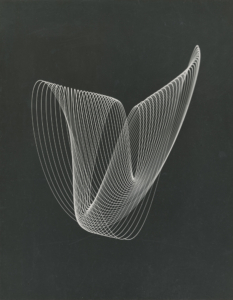
Konrad Cramer, Untitled (Sympalmagraph), n.d.
CPW’s exhibition Photography in the Abstract examines the shift within the tight-knit Woodstock community from Pictorialism to abstraction. The exhibition includes the photographs by Woodstock-based artists Konrad Cramer, Manuel Komroff and Nathan Resnick.
While abstraction was already practiced internationally in the early 20th century, from Laszlo Moholy-Nagy to Man Ray in Europe to Paul Strand and Aaron Siskind in the United States, it took much longer to reach the Hudson Valley. In Woodstock’s thriving art community, nature continued to inspire sweeping landscape paintings and idyllic photography of trees, pastures and the community within. A turning point came in the late 1930s, as New York City’s influence seeped into Woodstock’s pastoral settings.
Working in a medium that encourages experimentation, photographers in growing numbers gave in to the seduction of image manipulation. As can be seen in the photography of this transitional time, a sub-group of artists shifted from descriptive photographs that still carried the burden of authentic representation to gradual levels of abstraction through photo processes such as solarization, photograms, double exposure, and other in-camera and darkroom techniques.
Within the Woodstock community, Konrad Cramer (1988-1963) seems to have reached this point first. Starting as early as the 1930s, he solarized otherwise traditional still life compositions, but also developed his own technique to convert sound into line drawings and photographs. Coining the term “sympalmagraph,” two of these photographs were included in the 1951 survey exhibition Abstraction in Photography at the Museum of Modern Art (MoMA). Curated by Edward Steichen, the exhibition of 150 photographs by 75 artists sent shivers through the photographic art community.
Manuel Komroff (1890-1974) was a photographer, a playwright, screenwriter and prolific novelist. What is especially intriguing about Komroff’s work, is the visible transition from a straightforward photograph to intensified abstraction, often practiced with the same oak leaves, paper cutouts or other found objects.
Nathan Resnick (1910-1977), an avid photographer and Walt Whitman specialist, seemed to have worked closely alongside Cramer and Komroff and dipped into darkroom and camera abstraction around the same time. In a tell tale series depicting a picture window with vases, the objects are at first very recognizable, but in further experiments they become distorted blurs in an almost liquid reality. Before long, he shifted to experiments with light effects that abandoned most traces of representation.
All three artists were deeply connected to the community, where they lived and worked. Then as now, Woodstock stood out as a supportive and close-knit community of creative minds that spanned many disciplines, creating a nurturing vibrancy rarely seen elsewhere.
Images in banner (from left):
Konrad Cramer, Untitled (Still Life with Fans), n.d., from the collection of James Cox Gallery at Woodstock
Manuel Komroff, Untitled, n.d., from the collection of Jean Young
Nathan Resnick, Light Flowers 3, n.d., from the collection of Jean Young
All images are gelatin silver prints.
[/av_textblock]
[av_textblock size=” font_color=” color=” av-medium-font-size=” av-small-font-size=” av-mini-font-size=” av_uid=’av-jz8navi1′ custom_class=” admin_preview_bg=”]
ABOUT WOODSTOCK COLLECTS
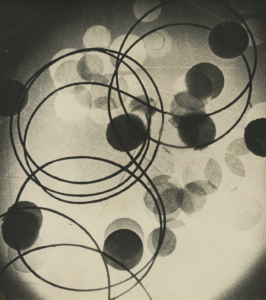
Manuel Komroff, Untitled, n.d.
The collaborative project Woodstock Collects culls the creative powers of five venues, which will each be opening an exhibition with a shared theme of art made and collected in Woodstock in the early 20th century. The resulting exhibitions showcase an exquisite mix of painting, sculpture and photography. Participating venues include the Center for Photography at Woodstock (CPW), the Historical Society of Woodstock, Woodstock Artists Association & Museum (WAAM), Woodstock Byrdcliffe Guild and Woodstock School of Art.
This collaboration directly builds on Woodstock’s inseparable relationship with the arts. Known as the colony for the arts for over a hundred years, artists and art lovers have flocked to Woodstock to live or to visit, to take in the beauty of the landscape and to enjoy the arts. Countless artists, musicians and otherwise creative minds have thrived in Woodstock’s nurturing environment; and many of them at some point decided to make this special place in the Hudson Valley their permanent home. Over the decades, countless works of art have been created in Woodstock, and a significant part of that art has remained in the community. Each of the participating venues has a collection of art and memorabilia. These collections are accessible and public. However, the works of art in private homes — often acquired directly from the artist — are hidden treasures.
The idea for this expansive collaboration was conceived by two board members of the Woodstock Byrdcliffe Guild, Abigail Sturges and Sylvia Leonard Wolf. It was put into action by an organizing committee that included the executive directors and presidents of all five organizations.
Sturges describes the goal of the collaboration “to delve into the rich collections of painting, drawings, sculpture, photographs, and some crafts in private homes in Woodstock. These works have rarely been seen in public spaces. Our purpose is also to demonstrate to Woodstock the power of a five-organization collaboration, and to reveal the importance of Woodstock art collections to a wider audience.”
In the end, this collaboration reflects Woodstock’s continued commitment to the arts and the relationship between the community, artists and art organizations. As art historian Susana Torruella Leval wrote in the catalogue’s afterword, “The vitality of these arts organizations mirrors the special energy of Woodstock—and also helps to power it. Artists have always been at the center of that power, infiltrating every facet of the town’s life and invigorating it, from the founding of Byrdcliffe in 1902 to the numerous art programs available in town on any given weekend.”
It has been CPW’s privilege to participate in this unprecedented collaborative effort. Executive Director Hannah Frieser joined Sturges on numerous scouting missions to private collections. Frieser states, “I started to participate in this project as soon as I moved to Woodstock. It was astonishing to see that a community as small as this one, cares so deelply about art and artists. That experience has shaped my understanding of Woodstock as a haven for artists. It also opened my eyes to the countless collectors in our midst, who have filled their lives with art, thereby becoming part of the fabric that makes Woodstock what it is.”
Copies of the 68-page catalogue, designed by Abigail Sturges, will be available at each venue. In addition to essays by each curator, the catalogue is narrated by essays and an afterword by art historian Susana Torruella Leval.
[/av_textblock]
[av_textblock size=” font_color=” color=” av-medium-font-size=” av-small-font-size=” av-mini-font-size=” av_uid=’av-jz8nx10j’ custom_class=” admin_preview_bg=”]
WOODSTOCK COLLECTS VENUES
Woodstock Byrdcliffe Guild
Woodstock Byrdcliffe Guild’s Legacy of the Arts: Friends, Families, Lovers
September 14-October 13, 2019
Jeremy Adams, Executive Director

Woodstock Artists Association & Museum
An Artistic Legacy 1+1+1
August 10-December 29, 2019
Janice La Motta, Executive Director and Curator

Historical Society of Woodstock
Heritage Through Art
September 14-October 27, 2019
Deborah Heppner, Board President
Woodstock School of Art
The Art Students League in Woodstock 1947–79
September 14–October 12
Nina Doyle, Executive Director

Center for Photography at Woodstock
Woodstock Collects: Photography in the Abstract
September 14-October 20, 2019
Hannah Frieser, Executive Director

[/av_textblock]
[av_textblock size=” font_color=” color=” av-medium-font-size=” av-small-font-size=” av-mini-font-size=” av_uid=’av-jz8o7qf3′ custom_class=” admin_preview_bg=”]
THANK YOUS
CPW’s warmest thanks go to collectors Jean Young and Jim Cox from the James Cox Gallery at Woodstock, who enthusiastically and generously made work from their collections available for this project. Thank you to all of our collaborative partners, who generously contribute to Woodstock’s supportive nature for artists and art lovers. It has been a pleasure to collaborate. Big thanks to Abigail Sturges and Sylvia Leonard Wolf, who conceived of this project that brought us all together. And a special thank you to art historian Susana Torruella Leval, who looked at all of our separate histories and projects, and beautifully wove them together into one narrative in the catalogue. Further thanks go to art historian Tom Wolf and gallerist Howard Greenberg for their support and advice.
CPW receives support from the New York Council on the Arts, the National Endowment for the Art, the Warhol Foundation, Joy of Giving Something, our members and other supporters, without whom this exhibition would not have been possible.
[/av_textblock]